
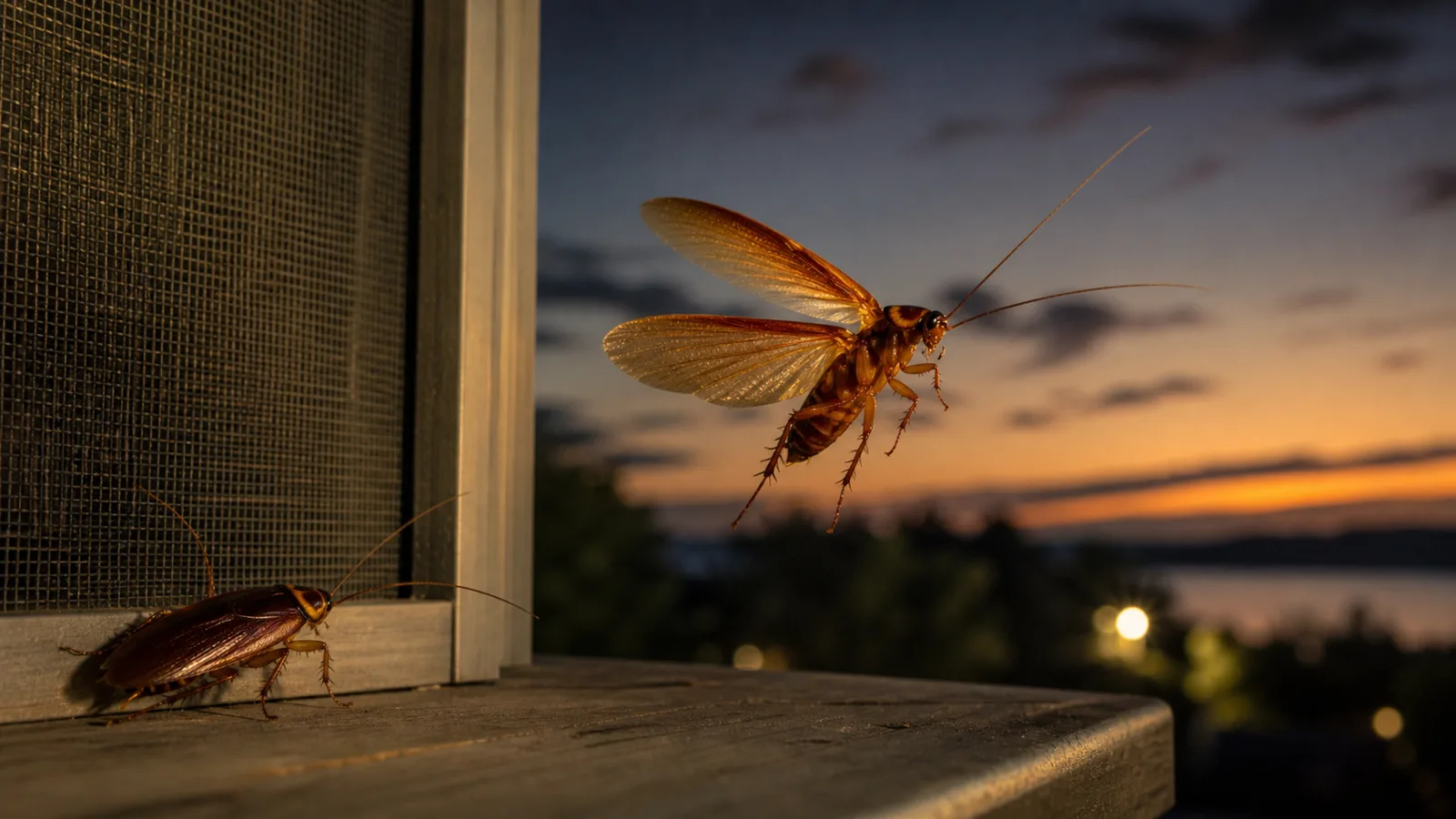
Some adult cockroaches can fly or glide, while others rarely or never fly. Wings alone do not prove strong flight: species, sex, temperature, disturbance, and wing development all affect behavior. Nymphs do not have functional adult wings.
Flight ability of common household species
| Species | Wing pattern | Typical behavior |
|---|---|---|
| German cockroach | Adults have wings | Usually runs; sustained flight is uncommon |
| American cockroach | Adults have developed wings | May glide or fly, especially in warm conditions |
| Oriental cockroach | Males have shortened wings; females have small pads | Does not normally fly |
| Brownbanded cockroach | Males have developed wings | Males may fly when disturbed; females are less capable |
| Outdoor wood cockroaches | Varies by species and sex | Males of some species readily fly to lights |
Why a cockroach may fly toward you
It is usually moving toward light, escaping disturbance, or making an uncontrolled glide—not attacking. Warm temperatures can increase activity. Remain calm, avoid spraying into the air, and capture or vacuum the insect if this can be done safely.
Wings as an identification clue
Compare how far the wings extend over the abdomen, overall size, color, thorax markings, and habitat. A winged adult plus small wingless nymphs in a kitchen suggests a reproducing indoor population. A single winged outdoor species at a lit window may be an accidental visitor.
What to inspect after a flying roach appears
- Window and door screens, weather stripping, and exterior-light locations.
- Roof, soffit, attic, and utility penetrations.
- Floor drains, plumbing gaps, basements, and crawlspaces.
- Mulch, leaf litter, firewood, and vegetation touching the building.
- Indoor monitors for nymphs or repeated adult activity.
Control depends on the source
For a reproducing indoor population, follow inspection, sanitation, exclusion, monitoring, and targeted treatment in the cockroach control plan. For outdoor invaders, improve screens and seals, move bright lights away from entrances where practical, and reduce close building harborage. Flying ability does not make foggers or broad spraying more effective.
Frequently asked questions
Can baby cockroaches fly?
No. Nymphs lack fully developed adult wings.
Can German cockroaches fly?
Adults possess wings but normally rely on rapid running. Seeing flight alone is not sufficient for species identification.
Do cockroaches fly more in summer?
Warm conditions increase activity and can make flight or gliding more likely in capable species.
Can cockroaches fly between apartments?
Movement through shared walls, pipe chases, doors, and transported items is generally more important than flight.
Flight does not determine infestation severity
A capable flier can be a single outdoor visitor, while a species that almost never flies can build a serious indoor population. Severity is better judged from frequency, life stages, monitor counts, fecal evidence, egg cases, and the number of rooms involved. Do not assume a wingless-looking nymph is a different pest.
Species and sex change wing appearance
Adult cockroach wings may cover the abdomen completely, extend beyond it, or remain reduced to pads. Males and females of the same species can differ. Damaged wings and partial views further complicate identification. Compare several features and the habitat rather than using one photograph of wings alone.
Immediate response checklist
- Capture a clear photograph and note the time and weather.
- Vacuum or contain the individual without crushing it on food-contact surfaces.
- Inspect the nearest door, window, vent, drain, or utility route.
- Place monitors along adjacent edges for at least one monitoring interval.
- Look for nymphs and repeated captures before choosing an indoor treatment.
Reduce attraction around entrances
Maintain screens, close door gaps, and consider fixture placement and shielding where exterior lights draw insects to entrances. Remove leaf litter and store firewood away from the structure. Manage vegetation without eliminating beneficial habitat unnecessarily. In apartments, report repeated activity because shared chases and neighboring units may require coordinated inspection.
Do not spray flying insects near people, flames, food, aquariums, or electrical equipment. Follow every pesticide label and prefer physical capture for an isolated visitor.
How cockroach flight works
Cockroaches have two pairs of wings when fully developed: tougher forewings cover and protect the thinner flight wings beneath. A species may have the anatomy for flight yet depend mainly on running. Wing loading, body size, sex, temperature, and air movement influence whether an adult takes off, glides downward, or simply uses its wings to stabilize a fall.
Flight patterns by indoor context
| Observation | Possible explanation | Best next check |
|---|---|---|
| Roach flies from a porch light | Outdoor species attracted to light | Screen, door seal, vegetation, exterior lighting |
| Large adult glides in an attic | Warm-site species entering roofline | Soffits, vents, gutters, overhanging access |
| Small adults run in kitchen | Indoor breeding species; flight is not important | Appliance and cabinet monitors for nymphs |
| Winged insect swarms near wood | May be termite or ant alates, not cockroaches | Body shape, antennae, waist, wing size |
Cockroach or another winged insect?
Winged termites have straight antennae, a broad waist, and four wings of roughly similar size. Winged ants have elbowed antennae and a pinched waist. Cockroaches have a flattened oval body, long threadlike antennae, a shieldlike pronotum behind the head, and spiny running legs. Collect a clear image before treatment because these pests require very different responses.
Why spraying the airborne insect is a poor strategy
An aerosol used toward a moving target can expose occupants and contaminate surfaces while doing nothing to a hidden population. For one visitor, physical removal is usually more controlled. For repeated activity, monitors and source inspection show whether the route is a screen, roof void, sewer connection, shared wall, or indoor harborage.
Seasonal considerations
Warm, humid evenings can increase outdoor cockroach activity and flight. Storms, landscape disturbance, and changes to drains or sewer systems can also produce sudden sightings. A seasonal spike does not eliminate the need to check for nymphs. Conversely, one adult during favorable flight weather does not automatically prove indoor reproduction.
Apartment and commercial-building response
Document the time, floor, room, and travel direction. Report repeated sightings early so management can inspect connected units, trash areas, utility chases, and service spaces. Sealing one apartment without coordinated monitoring can redirect movement. A building-wide integrated pest management plan is more effective than independent aerosol use.
Sources
Identification record to keep
Save the clearest photograph with the date, room, approximate size, temperature, and whether the insect flew, glided, or fell. Behavior is useful context but not a standalone identification feature. A repeatable record helps distinguish seasonal outdoor visitors from an indoor population and gives a professional better evidence than a verbal description made after the insect is gone.