
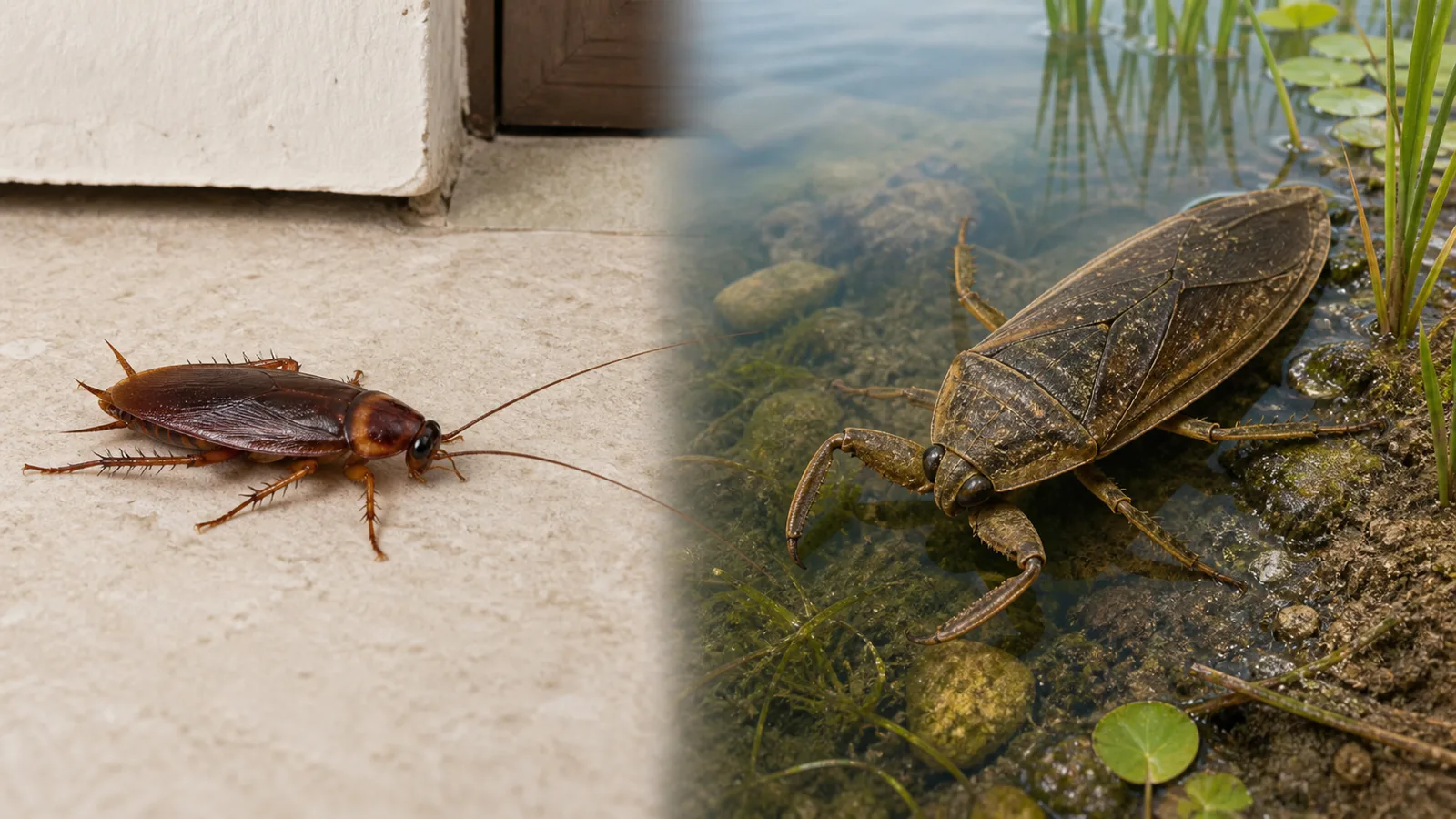
“Water bug” is an imprecise common name. People often use it for large outdoor cockroaches, especially American or Oriental cockroaches, but true aquatic water bugs are different insects. Identification should rely on body features, habitat, and behavior—not the nickname.
Quick comparison
| Feature | Cockroach | True aquatic water bug |
|---|---|---|
| Body | Flattened oval body; very long antennae | Broad aquatic body; shorter, less conspicuous antennae |
| Legs | Six running legs with visible spines | Legs adapted to swimming or grasping prey |
| Habitat | Buildings, sewers, leaf litter, mulch, utility spaces | Ponds, marshes, slow water, sometimes attracted to lights |
| Indoor pattern | May hide, forage, leave droppings and egg cases | Usually an accidental visitor rather than an indoor infestation |
Why large cockroaches get called water bugs
American cockroaches favor warm, damp sites such as sewer systems and utility areas. Oriental cockroaches are associated with cool, moist spaces, drains, crawlspaces, and outdoor debris. Their moisture association led to the water-bug nickname. German cockroaches are smaller and much more strongly associated with indoor kitchens and bathrooms.
Five-step identification
- Photograph the insect from above without handling it.
- Compare body length, color, wing coverage, and markings.
- Look at antenna length and leg structure.
- Record whether it came from a drain, wall void, doorway, pond, or outdoor light.
- Check for repeated sightings, nymphs, droppings, or egg cases indoors.
Use the detailed cockroach identification guide and German vs American cockroach comparison before selecting treatment.
Response if it is a cockroach
Inspect plumbing and sewer connections, repair leaks, screen drains where appropriate, seal utility gaps, manage mulch and debris near the building, and monitor wall edges. Repeated large-roach activity can indicate an exterior, sewer, crawlspace, or shared-building source. Target the source rather than routinely pouring pesticide into drains.
Response if it is an aquatic insect
Remove the individual without bare-hand contact, check screens and door seals, and reduce unnecessary lighting that attracts insects near entrances. True giant water bugs can bite defensively, so do not pick them up. A single light-attracted visitor does not justify indoor pesticide treatment.
Frequently asked questions
Can a water bug infest a house?
Aquatic water bugs generally do not establish household infestations. A cockroach being called a water bug can establish or repeatedly enter, depending on species and conditions.
Does finding one mean there are more?
Not always. Use monitors and inspect for additional evidence before drawing conclusions.
Are water bugs and palmetto bugs the same?
Both are regional common names often applied to large cockroaches; neither is a precise species identification.
Large cockroaches commonly confused by name
American cockroaches are reddish brown and commonly show a pale margin around the shield behind the head. Oriental cockroaches are darker, and females have strongly reduced wings. Smokybrown cockroaches are more uniformly dark brown and may be associated with warm, humid exterior harborages. Regional names such as palmetto bug, sewer roach, and water bug can refer to more than one of these insects.
Use population evidence, not fear, to choose control
A single adult beside a doorway after warm or wet weather calls for exclusion and monitoring. Repeated adults from a utility space suggest a persistent route. Nymphs of different sizes, egg cases, and concentrated fecal signs indoors point more strongly to reproduction. Place monitors along edges, not in the center of rooms, and identify captures before escalating treatment.
Drain-related precautions
Confirm that drain traps contain water and that unused fixtures are maintained. Repair damaged plumbing and gaps around pipes. Do not mix drain cleaners and pesticides or use an insecticide in plumbing unless the current label explicitly permits that site. Sewer-associated activity may require coordination with building maintenance or a plumbing professional.
What to photograph for identification
Capture the entire dorsal body, the area behind the head, wings, and a size reference without touching the insect. Also photograph the exact location and nearby entry feature. Clear evidence allows extension personnel or pest professionals to distinguish a structural infestation from an aquatic insect attracted to a porch light.
Cockroach species behind the “water bug” label
American cockroach
Adults are large, reddish brown, and capable of gliding or flight in warm conditions. They are associated with sewers, utility systems, commercial food areas, basements, and warm damp voids. Repeated indoor sightings should trigger inspection of plumbing routes and building infrastructure.
Oriental cockroach
This species is dark brown to nearly black and moves through cool, damp environments. It may occur around drains, crawlspaces, basements, exterior foundations, and decaying organic debris. Adults do not normally fly. Moisture correction and ground-level exclusion are central to control.
Smokybrown and other outdoor cockroaches
Some warm-region species live mainly outdoors in trees, mulch, gutters, and sheltered landscape sites but enter through rooflines or openings. Indoor pesticide alone will not correct exterior harborage and access.
True water bugs are predators
Giant water bugs and related aquatic insects live in freshwater habitats and prey on other organisms. Their front legs are adapted to grasping, and their antennae are not the long, threadlike structures typical of cockroaches. Adults of some species fly to lights. They can deliver a painful defensive bite, which is another reason to avoid bare-hand capture.
Decision tree for an indoor finding
- One insect beside a lit exterior door: photograph, remove, improve the screen or seal, and monitor.
- Repeated large roaches near drains: maintain drain traps, inspect plumbing and sewer routes, and involve building maintenance if needed.
- Nymphs or egg cases indoors: treat the finding as a reproducing cockroach population.
- Aquatic insect after outdoor lighting or storms: improve light and entry management; indoor infestation treatment is usually unnecessary.
- Identification remains uncertain: submit a clear specimen or photograph to an extension or qualified pest professional.
Common identification mistakes
Body size is often exaggerated when an insect moves quickly. Wet floors make any insect seem water-associated. Crushed specimens lose useful features, and online photographs may use regional common names incorrectly. Preserve the evidence without pesticide residue where safe, photograph it from several angles, and compare features from an authoritative regional guide.
Prevention around wet areas
Repair pipe and fixture leaks, maintain floor drains, clean organic buildup, seal penetrations, and improve ventilation in damp utility spaces. Outside, manage leaf litter and mulch depth close to the foundation, clear gutters, and repair door sweeps. These steps reduce both cockroach resources and accidental entry without unnecessary indoor spraying.