
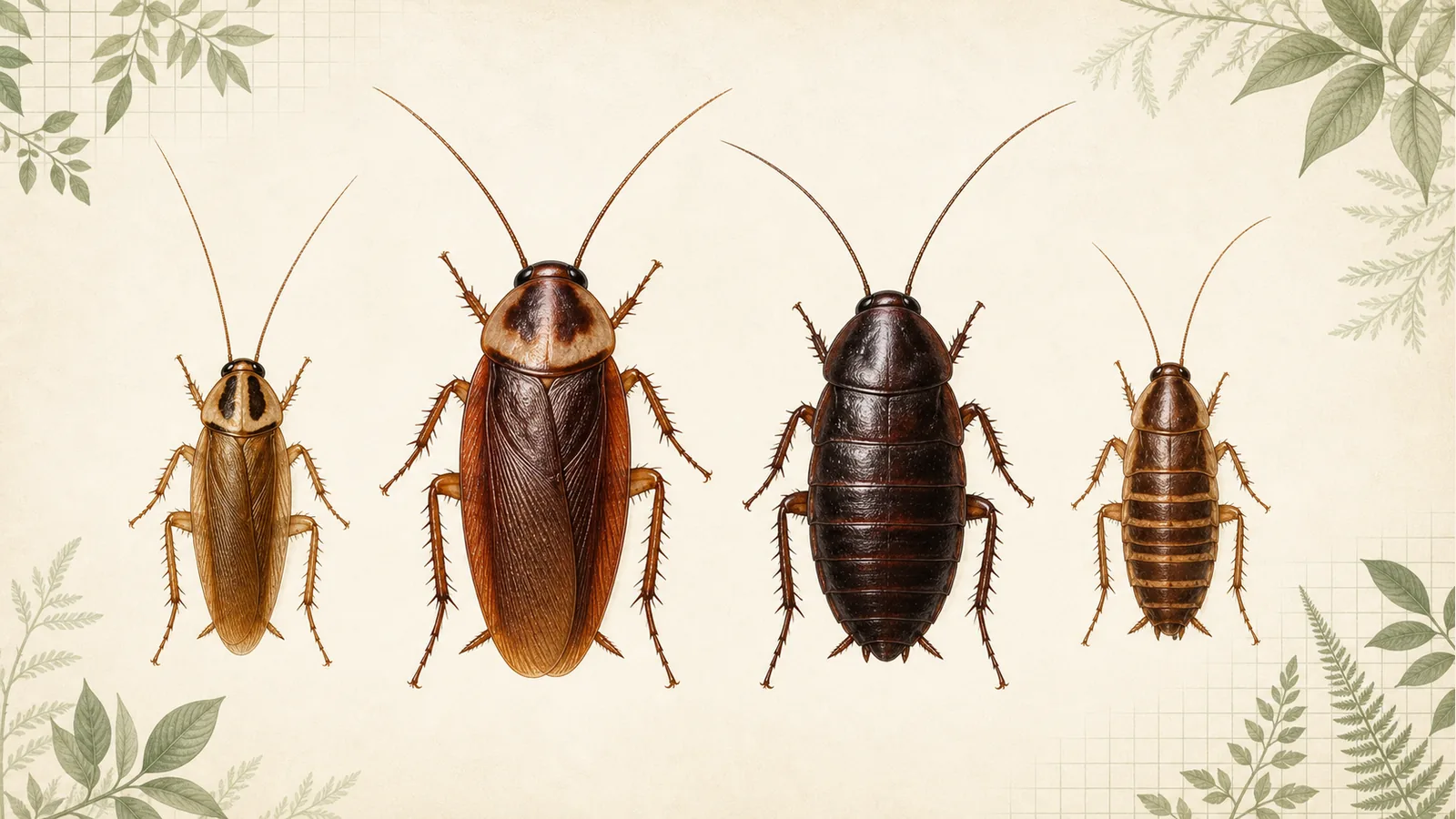
The fastest way to tell German and American cockroaches apart is size and the marking behind the head. German cockroaches are small, tan, and have two dark parallel stripes on the pronotum. American cockroaches are much larger, reddish brown, and typically have a pale yellow border around a darker pronotal marking. German cockroaches usually reproduce indoors near kitchens and bathrooms; American cockroaches are more strongly associated with sewers, drains, basements, boiler rooms, and other warm, damp spaces.
Key takeaways
- Small and striped: an adult around 1/2 inch long with two dark stripes is likely a German cockroach.
- Large and reddish: an adult roughly 1 1/2 inches long with a pale-edged pronotum is more consistent with an American cockroach.
- Location matters: German cockroaches cluster close to food, water, and warmth indoors; American cockroaches often enter from utility areas, drains, or exterior harborages.
- Treatment is not identical: German cockroach control emphasizes intensive indoor monitoring and bait placement, while American cockroach control also requires inspecting drains, pipe chases, basements, and exterior entry points.
German vs American cockroach comparison
| Feature | German cockroach | American cockroach |
|---|---|---|
| Adult size | Usually about 1/2 to 5/8 inch | Often about 1 1/2 inches or more |
| Color | Light brown to tan | Reddish brown |
| Marking behind head | Two dark, parallel stripes | Pale yellow border around a darker central area |
| Typical indoor location | Kitchens, bathrooms, appliances, cabinets, wall voids | Basements, drains, sewers, boiler rooms, crawl spaces |
| Flight | Adults have wings but rarely fly | Adults may fly or glide, especially in warm conditions |
| Infestation pattern | Frequently completes its life cycle inside buildings | May live in large utility spaces or outdoors and enter occupied rooms |
| Primary control emphasis | Indoor baiting, sanitation, monitoring, crack-and-crevice work | Source inspection, drain and utility correction, exclusion, targeted treatment |
How to identify a German cockroach
Adult German cockroaches are relatively small and narrow-bodied. Their most useful field mark is the pair of dark longitudinal stripes on the shield-like pronotum immediately behind the head. Adults have wings, although they generally run rather than fly.
Nymphs are smaller and darker than adults. They do not have developed wings and commonly show a lighter stripe along the center of the back. A small cockroach is not automatically a German cockroach, so compare the markings and capture a specimen on a sticky monitor when possible.
Where German cockroaches usually hide
German cockroaches favor tight, warm spaces close to food and moisture. Common harborages include cabinet hinges, gaps beside dishwashers, refrigerator motor compartments, voids around plumbing, and cracks near sinks. Seeing several life stages—including very small nymphs—usually suggests that reproduction is occurring nearby.
Use a flashlight and sticky monitors to map activity before applying products. Place monitors along edges and in concealed locations, not in the center of a room. Our baby cockroaches in the kitchen guide explains what juvenile sightings mean.
How to identify an American cockroach
American cockroaches are among the largest cockroaches commonly encountered in buildings. Adults are reddish brown with a pale yellowish margin around the pronotum. Their long wings cover or extend beyond the abdomen, and adults can sometimes fly or glide.
Young nymphs lack full wings and can be harder to distinguish from other large cockroach species. Size alone is not enough for a positive identification; the pronotal pattern, body color, wing development, and location should be considered together.
Where American cockroaches usually come from
American cockroaches are strongly associated with warm, humid environments such as sewers, floor drains, steam tunnels, basements, boiler rooms, commercial food areas, and decaying organic material outdoors. A single large cockroach in an upper living area may be an intruder. Repeated sightings around drains or utility penetrations indicate that the source needs to be traced.
Inspect floor drains, damaged screens, door sweeps, pipe penetrations, crawl spaces, and areas with condensation or leaks. In multifamily buildings, activity may extend beyond one unit, so building management may need to coordinate inspection and treatment.
Do they pose different health concerns?
Both species can move through contaminated environments and mechanically carry material onto surfaces. Cockroach body parts, fecal material, and shed skins can also contribute to indoor allergens. Risk depends on infestation level, sanitation, moisture, and exposure—not simply on seeing one insect.
Clean droppings with appropriate precautions, store food in sealed containers, repair leaks, and avoid leaving pet food out overnight. People with asthma or significant allergies should review our guide to cockroach allergens, cleanup, and control.
Why the species changes the treatment plan
German cockroach treatment priorities
- Use sticky monitors to identify concentrated harborages.
- Remove competing food, grease, crumbs, and standing water.
- Apply small placements of an appropriately labeled bait close to activity.
- Avoid contaminating bait with repellent sprays or harsh cleaners.
- Reinspect monitors and refresh placements according to the label.
- Seal cracks after activity has been reduced and hidden areas have been addressed.
American cockroach treatment priorities
- Determine whether the source is indoors, in a drain or utility system, or outside.
- Repair leaks, improve drainage, and remove damp organic debris.
- Seal pipe penetrations, repair screens, and install effective door sweeps.
- Clean and maintain accessible drains; do not pour pesticides into drains unless the product label specifically permits that use.
- Use labeled baits or targeted crack-and-crevice treatments where appropriate.
- Coordinate with property management or a licensed professional when common building systems are involved.
Safety note: The pesticide label is the legal and practical guide for where, how, and how much product may be used. Keep products away from children, pets, food, and food-contact surfaces. Do not use outdoor-only products indoors.
Common identification mistakes
- Calling every large cockroach an American cockroach: smoky brown, oriental, and other species can also be large.
- Calling every small cockroach a German cockroach: nymphs of larger species are also small.
- Using color alone: lighting, age, and specimen condition can change how color appears.
- Ignoring location: habitat is supporting evidence and often points to the source.
- Identifying from a crushed insect: capture an intact specimen or take clear photographs of the back and pronotum.
When to call a pest-control professional
Professional help is appropriate when German cockroaches are visible during the day, activity is spread across several rooms or units, treatment has repeatedly failed, or the source appears connected to sewers or shared utility systems. A professional can identify the species, inspect inaccessible harborages, coordinate treatment, and choose products for the actual site conditions.
Frequently asked questions
Which species is harder to eliminate?
German cockroaches are often more difficult inside kitchens and apartments because they reproduce indoors, hide in very small spaces, and can spread through adjoining units. American cockroaches may persist when a sewer, drain, basement, or exterior source remains uncorrected. In both cases, eliminating the source matters more than repeatedly spraying visible insects.
Can German and American cockroaches live in the same building?
Yes. They usually concentrate in different microhabitats, but a building can support both species. Sticky monitors in several locations can help show whether activity is concentrated around kitchens, drains, basements, or utility routes.
Does seeing one cockroach mean there is an infestation?
Not always. One American cockroach may wander indoors, while one German cockroach in a suitable indoor habitat is more concerning. Look for droppings, egg cases, shed skins, odor, and additional captures. See the complete guide to signs of a cockroach infestation.
Should I use a fogger?
Foggers do not reliably reach the narrow harborages where cockroaches spend most of their time and can increase exposure or drive insects deeper into voids. Targeted monitoring, sanitation, exclusion, and properly placed bait are generally more useful. Read our cockroach fogger safety guide.