
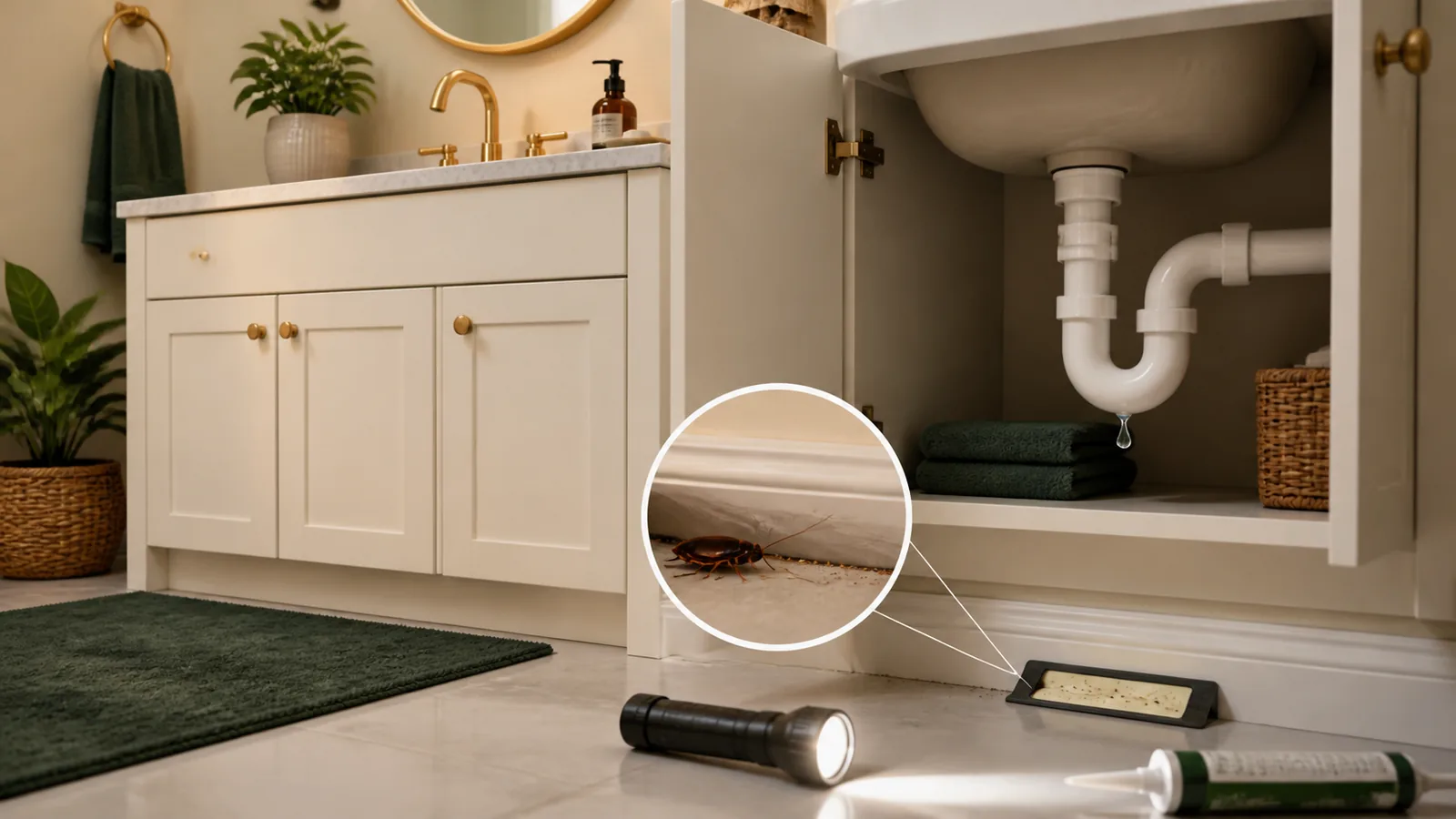
Cockroaches appear in bathrooms because the room offers moisture, warmth, shelter, and plumbing routes—not because they live in clean water or necessarily came through the toilet. Start by identifying the species, checking under the sink and around pipe gaps, repairing leaks, monitoring along wall edges, and tracing activity into adjoining rooms or shared building systems.
What to do first
- Photograph or capture an intact specimen for identification.
- Dry the sink, tub, floor, and vanity overnight and repair active leaks.
- Place sticky monitors under the sink, behind the toilet, and along wall edges.
- Inspect pipe penetrations, cabinet joints, baseboards, drains, and exhaust openings.
- Use targeted, label-approved control instead of spraying the entire room.
Why cockroaches show up in bathrooms
Bathrooms concentrate several resources cockroaches need. A slow plumbing leak, condensation on a toilet tank, damp bathmat, or residue inside a vanity can provide water. Pipe chases and gaps around drains connect hidden spaces between rooms, floors, and apartments. Warm motors, wall voids, and cabinet seams add shelter.
A clean bathroom can still have cockroaches if moisture or a shared route remains available. Conversely, cleaning alone will not eliminate an established infestation elsewhere in the building. The objective is to identify the source and make the bathroom less supportive while treating the actual harborages.
Did the cockroach come through the drain?
It is possible for some large cockroach species to be associated with sewer and drain systems, but a cockroach beside a drain did not necessarily emerge through it. The insect may have traveled along the outside of a pipe, through the wall opening around plumbing, from a cabinet void, or from an adjoining kitchen.
Frequently used plumbing fixtures normally have water-filled traps that help block sewer gases and many pests. Dry floor drains, damaged plumbing, missing strainers, and poorly sealed pipe penetrations deserve closer inspection. Do not pour insecticide into a drain unless the product label expressly allows that use.
Identify the type before choosing treatment
| What you see | What it may suggest | Where to inspect next |
|---|---|---|
| Small tan adults with two dark stripes | German cockroaches reproducing indoors | Vanity hinges, warm appliances, adjoining kitchen, plumbing voids |
| Very small dark nymphs | A nearby breeding population | Tight cracks, cabinet seams, pipe openings, shared walls |
| Large reddish-brown adults | American cockroach or another large species | Drains, basement, sewer routes, crawl space, exterior entry points |
| Large dark cockroach near a damp lower level | Moisture-associated species | Basement, floor drain, crawl space, leaking utility area |
Use our cockroach identification guide or compare German and American cockroaches. Identification from a blurry photo or crushed specimen is unreliable; a sticky monitor often produces a better sample.
Bathroom inspection checklist
Under the sink and inside the vanity
Remove stored items and use a flashlight. Look for droppings, shed skins, egg cases, grease-like spotting, live insects, water staining, and gaps around supply and drain lines. Check cabinet hinges and the narrow joint where the cabinet meets the wall.
Behind and around the toilet
Check the shutoff valve, supply-line opening, baseboard, and condensation-prone surfaces. A failed toilet seal requires plumbing repair; pesticide does not correct the moisture or sanitation problem.
Tub, shower, and floor drains
Confirm that strainers fit and rarely used drains do not remain dry. Inspect access panels and the perimeter where plumbing enters the wall. Clean organic buildup using an appropriate plumbing-maintenance method rather than mixing chemicals.
Shared walls and adjoining rooms
Bathrooms often share plumbing with kitchens, laundry rooms, or neighboring apartments. Monitor both sides of the wall. If captures occur in several rooms, treat the bathroom as one part of a broader infestation rather than the only source.
How to get rid of cockroaches in a bathroom
1. Remove dependable water sources
Repair dripping faucets, supply connections, and drain leaks. Wipe standing water before bed, hang towels to dry, ventilate after showers, and correct persistent condensation or humidity. Water reduction improves control but does not replace treatment when a population is established.
2. Monitor before and during treatment
Place sticky monitors flush against wall edges under the vanity, behind the toilet where accessible, and outside the bathroom door. Record the date and number captured. Replace dusty or wet monitors and compare results weekly.
3. Improve sanitation without contaminating bait
Remove hair, soap residue, trash, cardboard, and clutter. Store toothbrushes and personal-care items in clean closed locations while treating. Avoid spraying strong cleaners directly over bait placements because contamination can reduce bait acceptance.
4. Use bait in protected locations
If the product is labeled for the site, apply small bait placements close to confirmed activity in dry, inaccessible cracks and crevices. Do not put bait where it will be washed away, contacted by people, or reached by children and pets. Follow the label for placement size, interval, and renewal.
5. Seal routes at the right time
Seal gaps around pipes, cabinet edges, and baseboards with appropriate materials after inspecting and reducing activity. Large penetrations may need mesh or a backing material before sealant. Do not seal over an active leak or trap moisture inside a wall.
6. Address the connected source
If monitoring points to an adjoining kitchen, basement, drain system, or neighboring unit, expand the plan. Our seven-step cockroach control guide covers the whole-home process.
Bathroom safety: Never apply pesticide to surfaces that routinely become wet unless the label permits it. Do not treat toiletries, towels, toilet seats, tubs, shower surfaces, or other areas with direct skin contact. Never mix pesticides or improvise drain treatments.
Methods that commonly fail
- Spraying every visible surface: this increases exposure and misses hidden harborages.
- Using a fogger: fog does not reliably reach narrow cracks and may disperse cockroaches.
- Closing the drain but ignoring pipe gaps: insects often travel around plumbing rather than through the water-filled trap.
- Using bleach as insect control: routine cleaning is useful, but bleach is not a substitute for source correction and an integrated plan.
- Sealing immediately without monitoring: unresolved activity may shift into another room or remain behind the wall.
Bathroom cockroaches in apartments
In multifamily housing, plumbing and wall voids can connect units. Notify property management early, document captures and leak locations, and ask whether adjoining units or common utility areas will be inspected. Treating only one bathroom may provide temporary relief if the source is elsewhere. See our detailed guide to cockroaches in apartments.
When professional help is warranted
Contact a qualified pest-management professional when cockroaches are seen during the day, nymphs appear repeatedly, sticky monitors remain active after careful baiting, several rooms or units are involved, or the suspected source is a sewer, utility chase, or inaccessible wall void. Plumbing defects and persistent moisture may also require a plumber or building-maintenance professional.
Frequently asked questions
Can cockroaches come up through a toilet?
A functioning toilet contains a water barrier and is not the most likely route. Gaps around the toilet plumbing, damaged seals, shared pipe chases, drains, and nearby wall voids are more practical inspection targets.
Why do I only see them at night?
Cockroaches are generally most active when the room is dark and quiet. Nighttime sightings are common. Daytime activity can indicate crowding, disturbed harborages, or a larger infestation.
Will keeping the bathroom dry solve the problem?
Drying the room removes an important resource and strengthens the control plan, but an established population can obtain water elsewhere. Continue monitoring, sanitation, source inspection, and properly targeted treatment.