
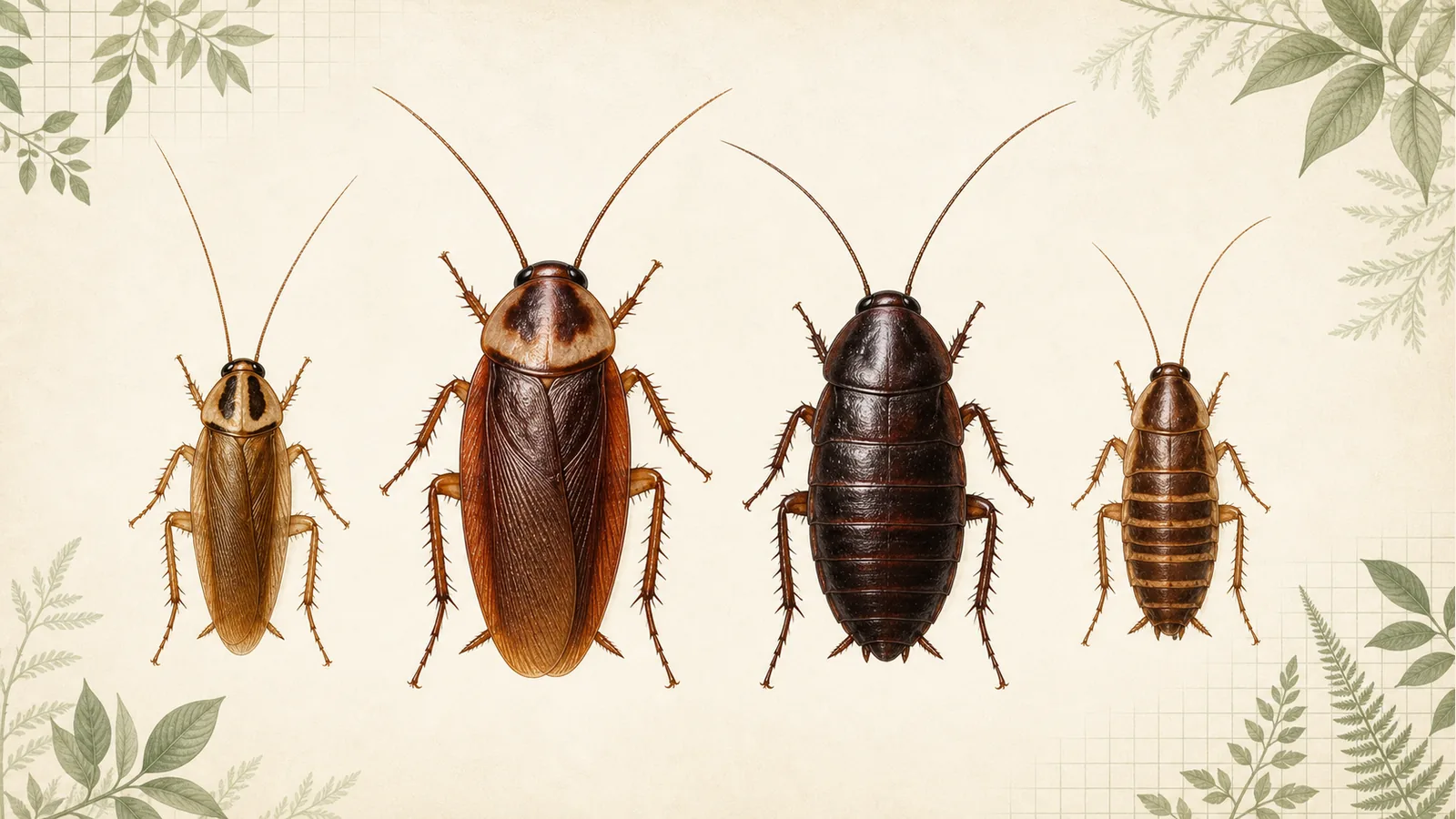
Cockroaches are flattened, oval insects with six spiny legs, very long antennae, and a shield-like plate behind the head. Color and adult size vary by species, from small tan German cockroaches to large reddish-brown American cockroaches. Wings may be present, but many household cockroaches rarely fly.
Fast identification
- German: small and tan with two dark stripes behind the head; common in kitchens and bathrooms.
- American: large and reddish brown with a pale marking on the pronotum; often associated with drains and utility areas.
- Oriental: broad, glossy, and very dark; favors cool, damp locations.
- Brown-banded: small with pale bands; often found in warm, dry, elevated locations.
Cockroach identification checklist
- Body: broad, flattened, and oval when viewed from above
- Antennae: a pair of long, threadlike antennae, often as long as the body
- Legs: six fast-running legs with visible spines
- Head: partly covered from above by the pronotum, a shield-like structure
- Color: tan, brown, reddish brown, or almost black depending on species and life stage
- Young cockroaches: wingless nymphs that resemble smaller, often darker adults
Do not identify a cockroach from color alone. Size, markings, wing length, life stage, location, and behavior all provide useful clues. A sticky trap can preserve a specimen long enough for a closer comparison.
Cockroach anatomy: what each feature tells you
| Feature | What to examine | Identification value |
|---|---|---|
| Pronotum | The shield immediately behind the head | Stripe and border patterns help separate common adults |
| Wings | Length relative to the abdomen and whether both sexes have full wings | Useful for adults, but not for wingless nymphs |
| Antennae | Long, thin, and highly mobile | Helps distinguish cockroaches from bed bugs and many beetles |
| Legs | Spines and running form | Separates cockroaches from insects with enlarged jumping legs |
| Location | Warm/dry, warm/moist, drain, basement, or outdoor edge | Often narrows the likely species more than color alone |
Four common household cockroaches
German cockroach
Adults are small and light brown to tan, with two dark parallel stripes on the pronotum behind the head. They favor warm indoor areas close to food and moisture, especially kitchens and bathrooms. Nymphs are darker and have a lighter area along the back. Persistent reproduction indoors makes this one of the most important species to identify quickly.
American cockroach
Adults are large, reddish brown, and usually have a pale yellowish border or figure-eight pattern on the pronotum. They are associated with sewers, drains, basements, utility areas, and other warm, damp locations. Their size often alarms occupants, but treatment should still begin by locating moisture and entry routes.
Oriental cockroach
Oriental cockroaches are dark brown to nearly black and appear broad and glossy. Their wings are reduced, especially in females. They often occur in cool, damp locations such as crawl spaces, basements, drains, and areas with decaying organic matter.
Brown-banded cockroach
This small species has pale bands across the wings or abdomen. Unlike German cockroaches, brown-banded cockroaches often occupy warmer, drier, elevated locations—including furniture, closets, wall decorations, and electronics—so an inspection limited to sinks and drains can miss them.
Baby cockroach or another insect?
A baby cockroach is a nymph, not a larva or worm. It has six legs, long antennae, and the same general flattened outline as an adult, but lacks developed wings. Very small nymphs can be confused with beetles, crickets, or bed bugs. Bed bugs have shorter antennae and a rounder outline; beetles usually have a harder, more domed body; young crickets have enlarged hind legs for jumping.
For kitchen sightings, see baby cockroaches in the kitchen. For egg cases and development, use our species and egg-case guide.
Cockroach look-alikes
| Look-alike | Key difference | Where confusion happens |
|---|---|---|
| Bed bug | Rounder, flatter body with shorter antennae and no rear cerci | Bedrooms and upholstered furniture |
| Ground beetle | Hard, domed wing covers and a less flattened outline | Accidental indoor visitors near doors and windows |
| Cricket nymph | Enlarged rear legs adapted for jumping | Dark basements, garages, and outdoor entry points |
| Termite reproductive | Two pairs of similar-length wings and a different body shape | Seasonal swarms near windows and lights |
| True water bug | Aquatic predator with grasping front legs; not a household-breeding cockroach | Near ponds, pools, and outdoor lights |
Identify before applying pesticide
A treatment chosen for a German cockroach infestation may be unnecessary for one outdoor beetle or unsuitable for an outdoor-associated cockroach entering through a drain. Capture and identify first, especially when sightings are isolated.
How to confirm an identification
- Capture the insect with a sticky trap placed against a wall.
- Photograph it from above beside a ruler or coin for scale.
- Record where and when it was found.
- Compare size, pronotum markings, wings, and body color with a reliable identification guide.
- If the specimen is unclear or infestations persist, ask a university extension service or licensed pest professional.
Correct identification matters because species that breed indoors require a different response from outdoor species that occasionally wander inside. After confirming activity, follow the seven-step cockroach control plan.
Frequently asked questions
Do all cockroaches have wings?
No. Nymphs are wingless, and adult wing development varies by species and sex. The presence of wings does not mean the insect regularly flies.
Are small cockroaches always babies?
No. Some adult species are naturally small. Look for developed wings, adult markings, and the shape of the pronotum rather than using size alone.
Can I identify a cockroach from a blurry photo?
Sometimes only to a broad group. A top-down photo with scale, location notes, and a captured specimen provides a more reliable identification.
Source
Substantially reviewed and updated: August 2026.
Need help narrowing down the species? Compare the markings, size, habitat, and treatment priorities in our German vs American cockroach guide.